

Bismillahir Rahmanir Rahim.
Allahumma salli ‘ala Muhammadin wa ‘ala ali Muhammadin, kama sallayta ‘ala Ibrahima wa ‘ala ali Ibrahima, innaka Hamidun Majid.
My dear brothers and sisters, have you ever loved someone so deeply that their pain kept you awake at night? Have you ever cried tears of fear and longing for someone you may not even have met? This is not a story from a novel or a movie. This is the true, heart-wrenching reality of our beloved Prophet Muhammad ﷺ, the Rahmat-ul-lil-‘Alameen (Mercy to all the worlds), and his profound, unimaginable love for you and me—his Ummah.
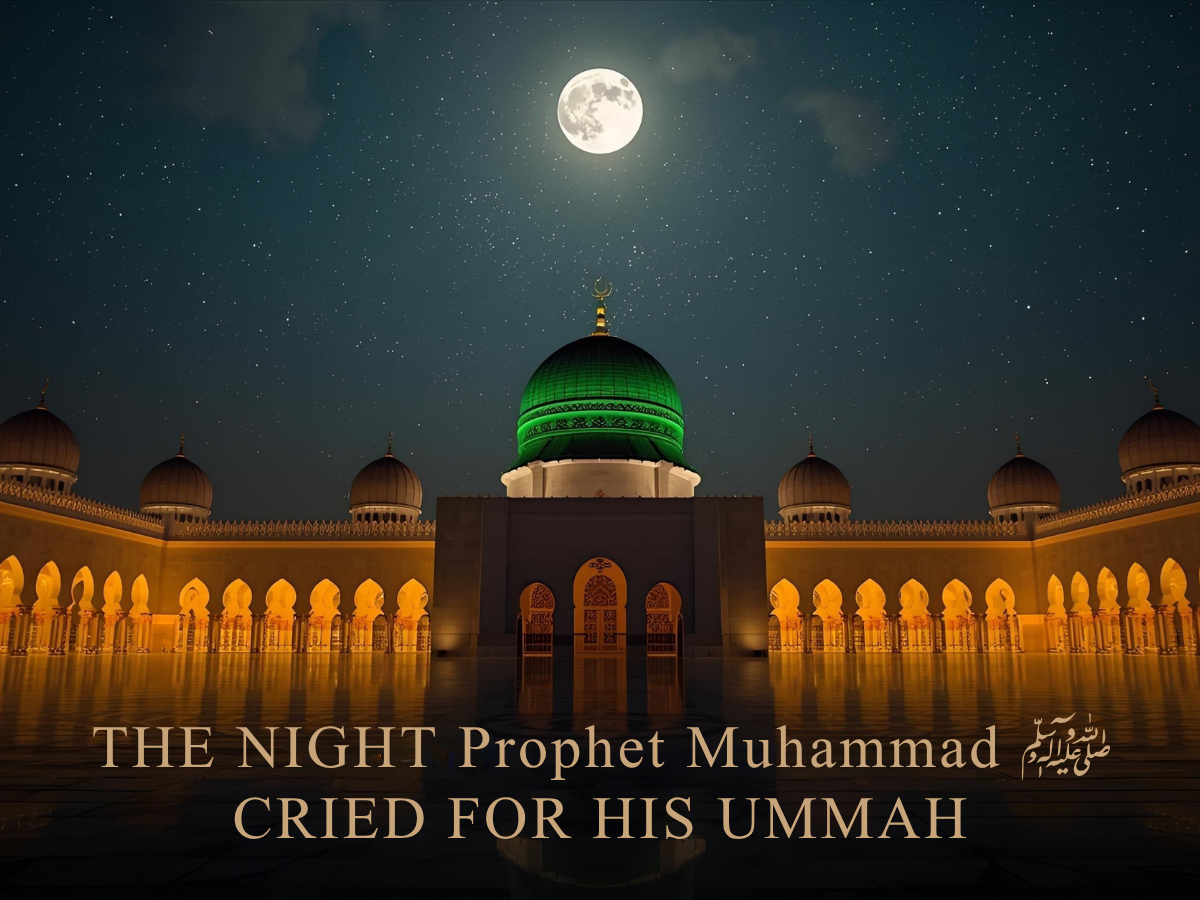
We often speak of our love for him ﷺ, but do we truly grasp the ocean of love he holds for us in his blessed heart? Let us journey back to a night that stands as a timeless testament to this love—a night when the Best of Creation ﷺ cried until the morning, his blessed cheeks wet with aansoo, his heart heavy with a concern that was solely for our sake.
The Long Night of Tears
Imagine the stillness of the night in Madinah. The world is asleep, but in the home of the Prophet ﷺ, there is no peace. His beloved wife, Sayyidah Aisha (RA), wakes to a sound that chills her to the core. It is the sound of stifled sobs. In the darkness, she sees the silhouette of the Messenger of Allah ﷺ. He is in prostration (sujood), but he is not still. His shoulders are shaking, and his whispers to his Lord are filled with such emotion that it feels the room itself is weeping with him.
Worried, she asks, “O Messenger of Allah, why are you crying? Has Allah revealed anything stern? Has a verse been revealed concerning you?”
But the answer he gives ﷺ is not about himself. It was never about himself. Even in his deepest moments of worship, his thoughts were with us.
He ﷺ lifted his head and replied, “Why should I not cry, when tonight, this verse has been revealed to me.” He then recited:
“Indeed, in the creation of the heavens and the earth and the alternation of the night and the day are signs for those of understanding. Who remember Allah while standing or sitting or [lying] on their sides and give thought to the creation of the heavens and the earth, [saying], ‘Our Lord, You did not create this aimlessly; exalted are You [above such a thing]; so protect us from the punishment of the Fire.’” (Surah Al-Imran, 3:190-191)
Then, he ﷺ said, “Woe to the one who recites this verse but does not ponder upon it.”
(Reference: Sunan Ibn Majah)
Think about it. A verse of immense beauty and depth was revealed—a verse inviting us to reflect on Allah’s creation and to make Dua for salvation. Yet, the Prophet ﷺ did not just feel joy at the revelation. His immediate, overwhelming thought was for his Ummah. He cried all night because he feared that some of us might read these words, but our hearts would remain unmoved. He cried because he was terrified that even after such a clear invitation, some of us might not reflect, might not understand, and might still be led astray, facing the consequences of our neglect.
A Love That Transcends Time
This was not a one-time occurrence. The entire life of our Nabi ﷺ was a symphony of love and concern for his Ummah. His Dua for us echoes through the ages:
“My Ummah, my Ummah!” (Sahih Muslim)
It is reported that on the Day of Judgment, when every soul will be worried about itself, Prophet Muhammad ﷺ will be on his knees, interceding for his Ummah, crying out, “My Ummah, my Ummah!” This is the man who, when given the choice between being a Prophet-King or a Slave-Messenger, chose the latter so he could be closer to his people—the poor and the needy. This is the man who, despite facing unbearable persecution in Ta’if, prayed not for vengeance, but for the guidance of the very people who stoned him until his shoes were filled with blood.
Allah Himself testifies to this in the Quran:
“There has certainly come to you a Messenger from among yourselves. Grievous to him is what you suffer; [he is] concerned over you and to the believers is kind and merciful.” (Surah At-Tawbah, 9:128)
“Aziz alayhi ma anti-tum…” It is grievous for him what you suffer. He is ‘aleemun alaykum—deeply concerned for you. Do you feel the weight of these words? Your pain, your struggles, your sins, your lack of iman—all of it causes him ﷺ pain. Your success, your repentance, your love for Allah—all of it brings him ﷺ joy.
How Do We Respond to Such a Love?
So, what is our duty? How do we respond to a love so pure, so selfless, that its owner cried all night for people he would never meet?
The first and most powerful response is to increase our Salawat upon him.
Allah commands it: “Indeed, Allah and His angels send blessings upon the Prophet. O you who believe! Send blessings upon him and salute him with a worthy salutation.” (Surah Al-Ahzab, 33:56)
Every time we say “Allahumma salli ‘ala Muhammadin wa ‘ala ali Muhammad”, it is not just a prayer. It is a connection. It is our way of saying, “Ya Rasulullah, we hear you. We feel your love, and we love you back.” It is a spiritual cord that links our hearts to his, across time and space.
Secondly, we must strive to be the Ummah he cried for. We must be the ones who ponder over the Quran. We must be the ones who remember Allah in every state. We must be the ones who, when we read the verse of reflection, actually stop and look at the sky, the mountains, the intricate design of a leaf, and feel the majesty of our Creator. We must be the ones who sincerely make the Dua: “Rabbana innaka man tudkhilin-nara faqad akhzaytahu… Our Lord, indeed whoever You admit to the Fire has been disgraced, and for the wrongdoers there are no helpers.” (Surah Al-Imran, 3:192)
A Call from the Heart: Join Us at KMY Academy
The story of that night is not just a historical event to be read and forgotten. It is a living lesson in love, responsibility, and our relationship with the greatest man to ever walk the earth. To understand his Seerah (life story) is to understand this love. To learn the Quran is to hear the very words that moved him to tears for our sake.
If you want to understand the love of Rasulullah ﷺ more deeply, if you want to learn what it means to be part of the Ummah he wept for, then we invite you with open arms.
Join KMY Academy to learn Quran and Seerah under qualified Islamic teachers.
Let us walk this path together. Let us study the Quran with the tadabbur (reflection) he desired for us. Let us delve into the Hadith and Seerah to know him ﷺ more intimately. Let us become an Ummah that not only benefits from his tears but also brings a smile to his blessed face on the Day of Judgment.
May our lives become a fitting response to his all-night vigil of love. May we be among those for whom his tears were not in vain.
Allahumma salli wa sallim wa barik ‘ala sayyidina Muhammadin, wa ‘ala alihi wa sahbihi ajma’een. Ameen.
